Hear it before you see it. That is the thing no photograph prepares you for. You are walking a steep path above Meiringen, a small town tucked into the Haslital valley of the Swiss Bernese Oberland, and the roar reaches you long before the water does — a deep, percussive thunder that seems to come from inside the mountain itself. Then the mist hits your face. Then you round the last bend and suddenly, 250 metres of falling glacial water fills your entire field of vision. The Reichenbach Falls. Millions of litres of snowmelt launched into open air, crashing onto black rock far below with a violence that makes the ground tremble.
You are standing at one of the most important sites in literary history. And if you have never heard of Sherlock Holmes, that sentence is about to make complete sense.
The Man Who Wanted to Kill His Own Creation
Arthur Conan Doyle created Sherlock Holmes in 1887. Within a few years, Holmes was the most famous fictional character on earth — a brilliant, coldly logical consulting detective operating from 221B Baker Street in London, solving impossibilities for a baffled Victorian public. Readers did not merely enjoy Holmes. They worshipped him. They wrote to him. Many, sincerely, believed he was real.
Doyle found this suffocating.
As early as November 1891, he wrote to his mother with barely concealed desperation: “I think of slaying Holmes in the sixth and winding him up for good and all.” He considered Holmes a distraction from the serious literary work he believed was his true calling — sweeping historical novels commanding critical respect rather than popular adoration. By 1893, his resolve had hardened into something final. He wrote to his mother again: “I am in the middle of the last Holmes story, after which the gentleman vanishes, never never to reappear. I am weary of his name.”
Holmes had to die. All that remained was finding a place grand enough, violent enough, and irreversible enough to make the death believable. Doyle went to Switzerland to find it.
Finding the Perfect Grave for Sherlock Holmes
In August 1893, staying in Lucerne, Doyle gave a talk at the Hotel de l’Europe to a small gathering that included two men who would inadvertently change literary history: Sir Henry Lunn, a medical missionary who was quietly inventing the modern British skiing holiday, and the Reverend W.J. Dawson, a clergyman and fervent admirer of Doyle’s historical novels. The three walked the Swiss hills together, debating religion and literature. Doyle confided he was looking for a location to kill Sherlock Holmes — somewhere that would feel, to readers, utterly inescapable.
Both Lunn and Dawson later claimed credit for what followed. According to Wikipedia’s account of the Reichenbach Falls, Sir Henry’s grandson Peter recalled his grandfather saying simply: “Push him over the Reichenbach Falls” — and that Doyle had never heard of them. The Victorian Web records that it was Dawson who selected the falls for Holmes’s dispatch. Historia Mag notes the credit was disputed, Dawson having “admitted or perhaps claimed” the honour in later years. The honest answer is that both men were present, both may have spoken, and neither conceded the glory to the other.
What matters is that Doyle made the journey to Meiringen and walked the path to the falls. When he saw them, he knew.

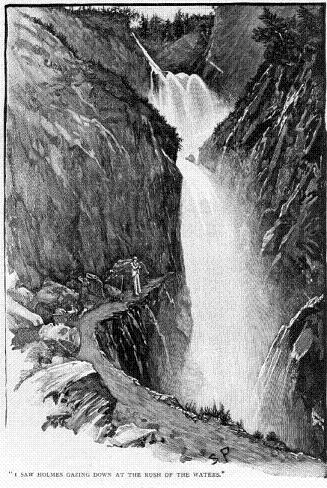
The upper fall alone drops 120 metres. In Victorian times, before safety rails and viewing platforms, the path beside the cascade was genuinely treacherous — narrow, spray-slicked, carved through rock, with the gorge dropping away into churning darkness. Watson’s narration in the eventual story captures exactly what Doyle would have witnessed: “a dreadful cauldron of swirling water and seething foam”, the waters turning “a man giddy with their constant whirl and clamour.” The place already carried artistic mythology: ninety years before Doyle arrived, the English Romantic painter J.M.W. Turner had stood in this same gorge in 1802 and rendered its violence in watercolour — his The Great Fall of the Reichenbach, in the Valley of Hasle, Switzerland now hangs at the Yale Center for British Art. Lord Byron and the Romantic poets had already mapped the Swiss Alps as a landscape of human extremity. Doyle understood that tradition. The falls were already a stage. He simply needed to write the final act.
He wrote in his notebook: “Killed Holmes.”
He was wrong.
The Fall — What Actually Happened
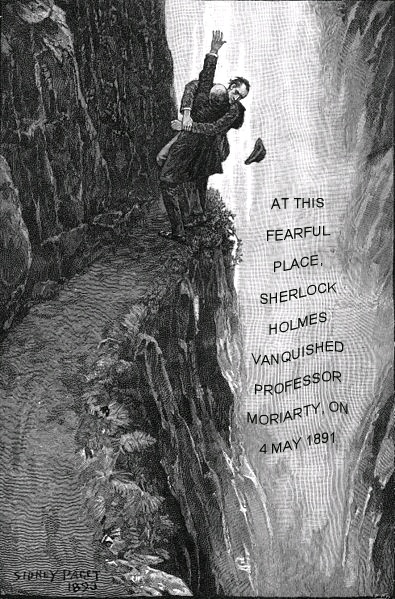
“The Final Problem” was published at Christmas 1893. Holmes and his arch-nemesis Professor Moriarty — “the Napoleon of crime,” his intellectual equal — are in flight across Europe. The chase ends at the Reichenbach Falls. Holmes sends Watson away on a false errand. When Watson returns, Holmes is gone. At the path’s edge, a letter: Holmes has gone to face Moriarty and does not expect to survive. Below, the black rocks and the churning cauldron. No bodies. Only the roar of the water, indifferent and endless.
Readers understood it as a death. Doyle intended it as one. But Holmes never actually fell.
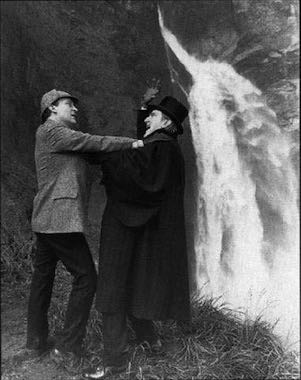
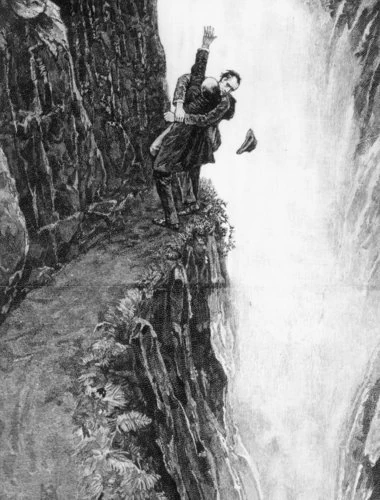
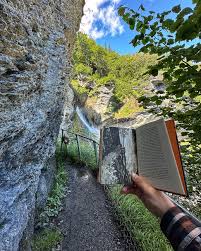
Ten years later, in 1903, Doyle brought Holmes back in “The Adventure of the Empty House.” Holmes explains, to a thunderstruck Watson, that he had used “baritsu” — a form of Japanese martial arts — to use Moriarty’s own momentum against him, sending the Professor into the abyss while Holmes himself clung to the rockface. He then faked his death and spent three years travelling Tibet, Persia, and France in disguise. Moriarty fell. Holmes watched him go.
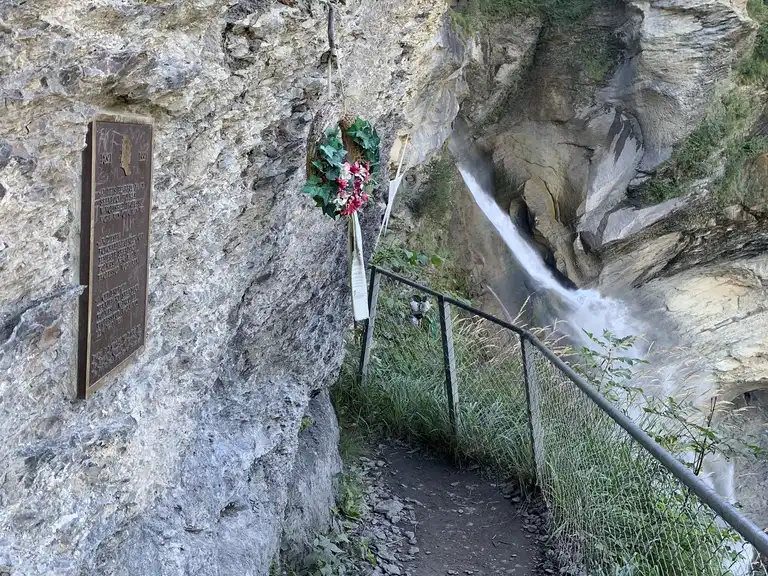
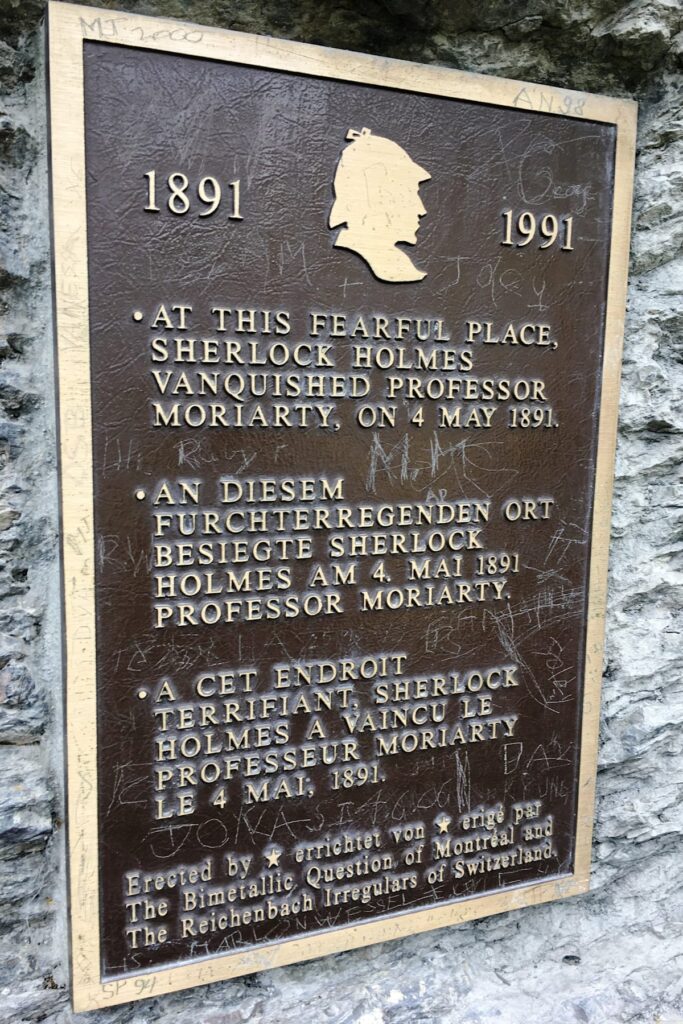
The plaque bolted to the rock at the ledge today reads: “At this fearful place, Sherlock Holmes vanquished Professor Moriarty, on 4 May 1891.” Note the word: vanquished. The date is fictional — two years before the story was even published. But the location is entirely real. Doyle wrote “Killed Holmes.” The plaque says Holmes won. That is the final, perfect twist in a story full of them.
The Detective Death That Shook the World
The public reaction to “The Final Problem” was unlike anything publishing had seen before or has fully equalled since. This was a mass emotional convulsion.
Over 20,000 readers cancelled their subscriptions to The Strand Magazine, the periodical that had published Holmes’s adventures monthly. The magazine very nearly went under. Stanford University’s Discovering Sherlock Holmes project records that the staff referred to Holmes’s death forever after as “the dreadful event” — a phrase normally reserved for genuine bereavements. Young men in London wore black crepe bands on their hats, the same mourning custom worn for real deaths. Doyle received threatening, grieving letters by the hundreds. Readers were not complaining about a story. They were accusing him of murder.
What the Reichenbach Falls achieved in 1893 was something with no precedent: it proved that a fictional character could be mourned as a human being. The grief was genuine. The sense of personal loss was real. What we now call fan culture — the passionate, possessive attachment to fictional worlds — was born, in some measurable sense, on the ledge above a Swiss waterfall in the Bernese Oberland.
The Return — and Why It Really Happened
Doyle held out for a decade. He wrote historical novels, ran for Parliament, pursued other work. But the pressure — from readers, publishers, and his own finances — never relented.
The real reason Holmes returned in 1903 was not sentiment. Doyle’s first wife, Louise, had been seriously ill with tuberculosis for years. The costs of her care, combined with building his Surrey home, had taken a severe financial toll. Holmes was the most bankable character in English literature, and Doyle knew it. The resurrection was a financial decision as much as a creative one. “The Adventure of the Empty House” ran in The Strand in October 1903 and sold immediately. It was magnificent. It was also necessary.
He could not kill Holmes. He could not keep him dead. The falls that were chosen as a grave had made him immortal instead.
The Falls Today
The water still drops 250 metres in total, the upper fall alone plunging 120 metres. The roar is still audible from the valley floor. The mist still settles on the rocks. The path is still narrow.
The Reichenbachfallbahn — an electric funicular with faithfully restored wooden carriages, carrying 24 passengers per car — opened in 1899, just six years after “The Final Problem” was published, built specifically to manage the tide of visitors Doyle’s story had created. A memorial plate at the lower station commemorates Holmes. Switzerland Tourism describes the nostalgic railway as the right way to arrive — an unhurried ascent while the valley drops away below.
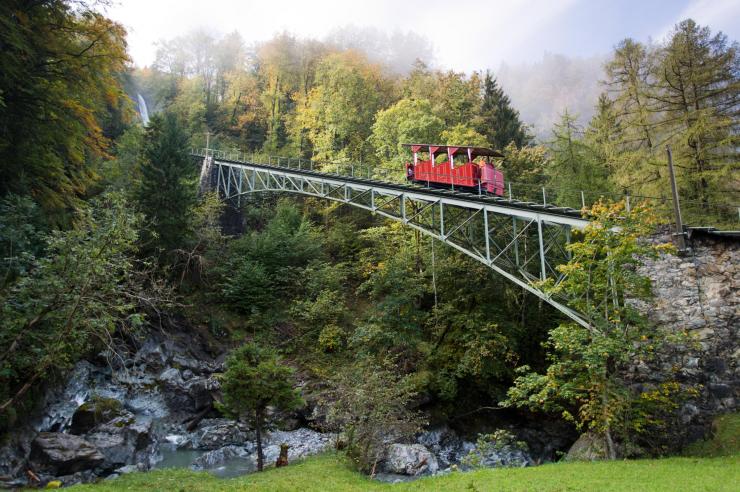
The plaque itself sits on the far side of the falls from the funicular, reached by climbing to the top, crossing a bridge, and descending to the ledge. The path has eroded over a century and a half; the ledge now sits further from the water’s edge than Doyle would have known. But the words are still there. The gorge is still below.
In Meiringen, the Sherlock Holmes Museum occupies the basement of the former English Church — the same church that stands near the Park Hotel du Sauvage, where Holmes and Watson stayed in the story. It opened on 4 May 1991, the fictional centenary of Holmes’s battle with Moriarty, in the presence of the Sherlock Holmes Society of London and Dame Jean Conan Doyle, the author’s daughter. Inside: the world’s only full reconstruction of the parlour at 221B Baker Street. Outside: a bronze statue at Conan Doyle Place. Meiringen formally granted Sherlock Holmes honorary citizenship on 8 May 1987 — his nominal 100th birthday. He is, officially, a citizen of the Bernese Oberland.
Henry Lunn — who may or may not have first suggested the falls as the perfect grave — went on to found the Public Schools Alpine Sports Club in 1903, establishing the infrastructure of the British Alpine skiing holiday. His son Arnold later invented slalom skiing. A man who helped kill the world’s greatest detective also invented the modern ski holiday. History produces figures like this more often than it should.
Things to Do Here
Ride the Reichenbachfallbahn. The electric funicular with its restored wooden carriages runs from a station near Meiringen. It is the correct way to arrive — a slow, deliberate ascent that builds the anticipation as the valley falls away.
Walk to the plaque. From the upper funicular station, follow the path to the top of the falls, cross the bridge, descend to the ledge. Read the words. At this fearful place, Sherlock Holmes vanquished Professor Moriarty, on 4 May 1891. Take a moment with them.
Visit the Sherlock Holmes Museum in Meiringen. The world’s only full reconstruction of the 221B Baker Street parlour, housed in the former English Church. The museum rewards proper time — the detail is extraordinary, and the context it provides makes the waterfall visit complete.
Hike the Aare Gorge (Aareschlucht). A short distance away in the Haslital valley, this glacially carved limestone gorge is one of the most dramatic short walks in the Bernese Oberland.
Stay until late light. The morning mist is spectacular. The late afternoon, when the gorge falls into shadow while the upper cliffs remain lit, is something else. The place was chosen for its drama. Two centuries after Turner first painted it, the drama remains, entirely unchanged.
The Reichenbach Falls are located 1.5 km south of Meiringen in the canton of Bern, Switzerland, approximately 30 minutes from Interlaken by train. The Reichenbachfallbahn funicular operates seasonally; check Meiringen Tourism for current opening dates and times.