Tolkien’s writing and imagineering have inspired and mesmerized the world for decades. His sub-creation theory and practice are well understood but how did he come up with specific middle-earth locations and individual characters. Regarding the latter there is one main Lord of the Rings character that merits this questions most: Where did Gandalf come from? How did Tolkien come up with his visual appearance and his magical character? Discover how a souvenir postcard bought in Interlaken and an eccentric Victorian aunt inspired Tolkien’s most famous wizard.
J.R.R. Tolkien — The Birth of Gandalf
The Dual Alchemy of Character Creation
While the towering, mist-hung cliffs of the Lauterbrunnen Valley gave a young J.R.R. Tolkien the sweeping geographical blueprint for Rivendell, the bustling resort town of Interlaken provided him with something equally invaluable: the seed of literature’s greatest wizard. The story of Gandalf the Grey does not begin deep in the caverns of Middle-earth. It begins in the summer of 1911, on the dusty mountain roads and haystack sleeping quarters of the Swiss Alps, with a party of twelve — and the formidable woman who led them.
The creation of Gandalf involves a fascinating, precisely documented duality: a chance encounter with a piece of Swiss tourist art, and the irresistible personality of an eccentric, trailblazing Victorian woman. Together, they gave us a wizard who is simultaneously ancient and humorous, terrifying and tender, commanding and deeply compassionate. Understanding how that happened requires a short lesson in how imagination actually works — not in a flash, but slowly, across decades.
The Summer of 1911: Head Over Heels into the Alps
Tolkien sat his last school examinations at King Edward’s School, Birmingham, on 26 July 1911. Within days — almost certainly weeks — he was gone, swept up in what he would later describe as a journey taken “head over heels,” in a phrase that would echo in the opening of The Hobbit itself.
The expedition was organised by the Brookes-Smith family, friends of the Tolkiens, who invited young J.R.R. (nineteen years old) and his brother Hilary to join them. What assembled was a party of roughly twelve, plus a local guide — a number Tolkien himself later noted with quiet amusement was almost exactly the size of Bilbo’s company in The Hobbit. The group included Tolkien’s aunt, Jane Neave, who by most accounts was the party’s real animating force.
Their route, as reconstructed from guest-book signatures, letters and an unpublished account by Colin Brookes-Smith, was formidable: from Interlaken through Lauterbrunnen and Mürren, eastward over the Kleine and Grosse Scheidegg past the looming faces of the Eiger and Mönch, on through Meiringen and the Grimselpass, south to Brig and the Aletsch Glacier, and eventually all the way to Zermatt — a journey of at least 315 kilometres on foot, with some 20,000 metres of height gain, according to A Lion’s Switzerland. They carried great packs, walked almost entirely by mountain paths, avoided roads, never booked accommodation ahead of time, and slept rough — men in haylofts and cowbyres, under open skies.
Tolkien described it himself in a letter to his son Michael fifty-seven years later (Letter 306, 1968):
“We went on foot carrying great packs practically all the way from Interlaken, mainly by mountain paths, to Lauterbrunnen and so to Mürren and eventually to the head of the Lauterbrunnenthal in a wilderness of morains.”
J.R.R. Tolkien
Reading that sentence, and knowing what The Hobbit contains, is a strange and satisfying experience. Here is the dwarf-company’s exhausting trek through mountain wilderness. Here is the weariness and the wonder, side by side.
The dangers were real. Near the Aletsch Glacier, the summer heat was melting the snowfields above the party’s path, sending boulders rolling down the exposed slopes — rocks, as Tolkien recalled, ranging “from the size of oranges to large footballs,” shooting between members of the strung-out party. One passed within a foot of Tolkien’s knees. The group also endured a violent thunderstorm that scattered them in darkness, forcing the men to shelter in a cattle-shed; they climbed roped to high Alpine huts; they narrowly avoided a snow-crevasse. In Letter 232 (1961), Tolkien explicitly confirmed that some of these events found their way into The Hobbit, as recorded by A Lion’s Switzerland. The stone-giants hurling boulders at each other in the Misty Mountains, the drenched and desperate company sheltering in the dry cavern — these are not fantasy. They are dispatches from August 1911.
Before the party turned for home, Tolkien paused to look back at the Jungfrau. He wrote:
“I left the view of the Jungfrau with deep regret: eternal snow, etched as it seemed against eternal sunshine, and the Silberhorn sharp against dark blue: the Silvertine (Celebdil) of my dreams.”
Celebdil — the silver peak above Moria, where Gandalf and the Balrog fought their last battle on the mountain-top — is the Silberhorn of the Bernese Oberland, seen from Kleine Scheidegg. Tolkien said so himself.
The Aunt Who Led the Fellowship
A company of twelve sets off on a long, dangerous journey through wild mountain country, under the authority of an older figure of commanding intelligence and great personal force — this is the frame of The Hobbit, but it is also an accurate description of the 1911 Swiss expedition.
Jane Neave was Tolkien’s mother’s elder sister, and one of the most remarkable women in his life. At a time when higher education for women was regarded with suspicion or outright hostility, Jane had earned a degree in botany and geology from the University of London — largely by correspondence course, since women were not yet permitted to attend lectures in person. She went on to teach science at girls’ high schools in Liverpool and then Birmingham, until the prevailing policy against married women working forced her to leave when she wed Edwin Neave. She was, in Tolkien’s own words, “one of the first” women to take a science degree — he cited it with unmistakable pride, according to Reddit’s Tolkien fans community.
The relationship between Tolkien and his aunt was close and enduring. She would later purchase a farm at Dormston, Worcestershire — at the end of a lane which local people, as Tolkien biographer Humphrey Carpenter records, sometimes called “Bag End.” Tolkien chose that name for Bilbo’s home; it was not invented. It was borrowed, with affection, from the place associated with Aunt Jane.
On the 1911 expedition, Jane Neave was the one who organised the itinerary, set the pace, and led the party across some of the most demanding terrain in Europe. She walked ahead of a group of exhausted young men — walking stick in hand, wide-brimmed hat cutting her silhouette against the mountain sky — with what the AFAR travel magazine describes as the authority of “a quirky aunt” whom Tolkien researchers recognise as a partial model for Gandalf. The echoes are unmistakable: a wise, sometimes frustrating older figure leading a band of inexperienced travellers into danger they could not have anticipated, for purposes that gradually become clear.
Tolkien himself noted the eerie parallel between the size of the 1911 party and the company he later assembled in The Hobbit. One member of the Swiss group he described, with characteristic warmth, as “one of the hobbits.” The expedition had its own Bilbo.
Der Berggeist: The Postcard That Named a Wizard
This is where the story becomes, for Tolkien scholars, genuinely puzzling — and where the puzzle turns out to be more interesting than any simple answer.
Humphrey Carpenter, in his authoritative 1977 biography, recorded that before the party set off on its return journey to England, Tolkien purchased a number of picture postcards. Among them was a reproduction of a painting by the German artist Josef Madlener, entitled Der Berggeist — The Mountain Spirit. Carpenter describes the image with precision: “an old man sitting on a rock under a pine tree. He has a white beard and wears a wide-brimmed round hat and a long cloak. He is talking to a white fawn that is nuzzling his upturned hands, and he has a humorous but compassionate expression; there is a glimpse of rocky mountains in the distance.” Tolkien preserved the postcard carefully, and wrote on the paper cover in which he kept it three words in his own hand: Origin of Gandalf.
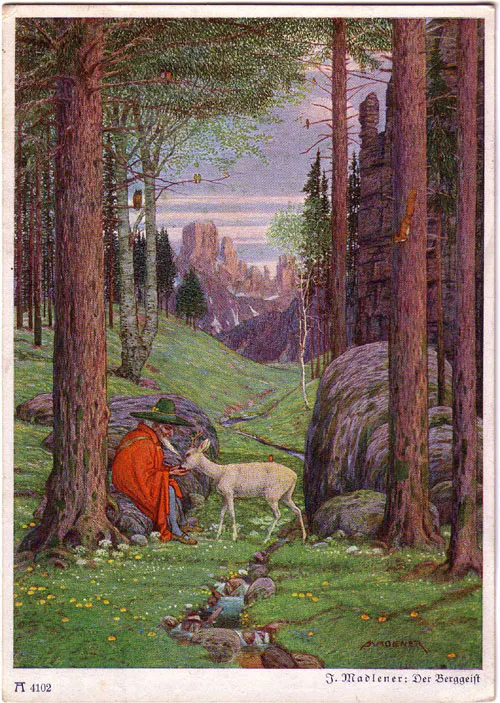
The problem, as the Tolkien scholar Manfred Zimmerman established in his research published in Mythlore, is that Madlener’s painting could not have existed in 1911. According to the artist’s daughter, it was most likely painted in the mid-to-late 1920s, and the postcard was not printed until around 1935. A postcard of a painting that did not yet exist could not have been purchased in a Swiss souvenir shop in the summer of 1911. As the Denney Home Place blog notes, “he cannot very well have acquired the postcard in 1911 already.”
Carpenter’s account appears to have placed the postcard at the wrong point in the story. It is currently accepted among Tolkien scholars that the postcard was acquired sometime in the later 1920s — around the very period when Tolkien began telling his children the tales that would eventually become The Hobbit, as TheOneRing.net reported when Madlener’s original painting was rediscovered and auctioned at Sotheby’s in 2005.
But here is what makes the story more fascinating, not less: Tolkien himself clearly understood the postcard and the 1911 journey as belonging together. In his imagination, the mountain spirit on the postcard and the expedition through the Bernese Oberland were fused. The image confirmed and crystallised what the journey had planted. This is how the imagination actually works across decades — not as a single lightning bolt, but as a slow accretion of experience, image and memory, until one day a figure you have been building unconsciously for twenty years steps forward, fully formed, and asks you for eleven dwarves.
The original Madlener painting, long known only through the few surviving postcards, eventually surfaced and was auctioned by Sotheby’s in London in July 2005 — by which point it had acquired, as the Mythlore article notes, a legendary status in Tolkien studies.
What Der Berggeist Actually Shows
It is worth pausing on the painting itself, because the details matter enormously.
The old man in Der Berggeist does not merely look ancient or otherworldly. He looks humorous. Carpenter specifically uses the phrase “humorous but compassionate” to describe his expression — and this is the key to why Tolkien kept this particular postcard among all others. The figure in the painting is not a solemn, remote sage. He is someone who finds the world quietly, endlessly amusing, who extends his hands to a wild creature with the ease of long acquaintance.
That white fawn nuzzling his upturned palms is not incidental. Gandalf’s affinity with wild creatures is a defining trait throughout The Lord of the Rings — he arrives on the back of Gwaihir the Wind-lord, the great eagle; he is known to, and trusted by, animals that distrust all others. The man in Madlener’s painting is not commanding the fawn. He is simply present to it, and the creature has come of its own accord. Behind them, rocky peaks press against the sky.
Wildness, wisdom, humour, compassion — these four qualities, held in the same figure, are precisely what Gandalf is. They are also, in their way, what the Alps themselves contain: the austere and the tender existing in the same moment, the dangerous and the beautiful inseparable. Tolkien saw this in the mountains. He recognised it in the postcard. The envelope labelled “Origin of Gandalf” was, in the end, a note to himself: this is what I have been trying to describe.
Stand Here: The Höheweg Promenade, Interlaken
Walk the same tree-lined promenade where a nineteen-year-old Tolkien prepared to set off on the journey that would, over the following decades, reshape the whole of English fantasy literature. The Höheweg in Interlaken — flanked by its grand Belle Époque hotels and souvenir shops — is the departure point for what is arguably the most consequential walking holiday ever taken.
The mountains Tolkien named for Celebdil, Barazinbar and Zirakzigil are visible from the valley on a clear day: Jungfrau, Mönch and Eiger, standing at the head of the valley like three great sentinels. He saw them. He wrote about them. And something in him — something that would surface twenty years later in a book he initially told his children as a bedtime story — never quite came home.
Things to Do Here
- Browse the traditional woodcarving and souvenir shops along the Höheweg for authentic alpine crafts — Tolkien was not the last visitor to leave Interlaken carrying something he could not quite explain.
- Visit the Touristik-Museum in Unterseen, a short walk from the Höheweg, which explores 250 years of alpine tourism history and the era of Victorian adventurers who shaped the region.
- Take the funicular up to Harder Kulm for a panoramic view of Interlaken, Lake Thun, Lake Brienz and the three great peaks — the closest thing available to a wizard’s-eye perspective on the landscape Tolkien carried in his imagination for the rest of his life.
- Walk or take the train south into the Lauterbrunnen Valley, where the 72 waterfalls and sheer 300-metre rock walls make it almost impossible not to think of Rivendell — and where Tolkien’s name is recorded in the guest book of the Ober Steinberg Berg-Gasthaus, dated 5 August 1911.
Sources: Humphrey Carpenter, J.R.R. Tolkien: A Biography (1977); Tolkien, Letter 306 (to Michael Tolkien, 1968); Manfred Zimmerman, “The Origin of Gandalf and Josef Madlener,” Mythlore, https://dc.swosu.edu/mythlore/vol9/iss4/7/; A Lion’s Switzerland, https://alionswitzerland.com/tolkien-hobbit-lotr-switzerland/; Denney Home Place, https://denneyhomeplace.wordpress.com/2019/10/28/our-own-dear-john-ronald-origin-of-gandalf/; Tolkien Schweiz, https://tolkien-schweiz.ch/1911; AFAR Magazine, https://www.afar.com/magazine/following-in-the-footsteps-of-j-r-r-tolkien-in-switzerland; TheOneRing.net, https://www.theonering.net/torwp/2005/06/24/24318-painting-that-was-inspiration-for-gandalf-to-be-auctioned/