In July 1852, Wagner walked to the meadow above Wengen with the freshly written libretto of Die Walküre and found the landscape he had already written, waiting for him. He called it non-communicable. He put it in the music anyway. The Ride of the Valkyries has sounded like these mountains ever since.
Wagner’s Walküre and the landscape it inspired
On 28 May 1849, Richard Wagner crossed Lake Constance on a steamer to Switzerland. He was a political refugee and a wanted man. The Dresden barricades had fallen weeks earlier and he had spent the intervening time in hiding, his escape made possible only through the intervention of Franz Liszt. His post as Kapellmeister at the Dresden court — his income, his standing, his country — had been erased overnight. He was thirty-five years old and could not return to Germany on pain of arrest.
He settled in Zurich. In exile, he did not retreat. He wrote to a friend that he intended, through the Ring cycle he was beginning to conceive, “to make clear to the men of the Revolution the meaning of that Revolution, in its noblest sense.” This was not escapism. This was politics conducted in myth. He was building a four-opera cycle — fifteen to sixteen hours of music across four evenings — drawn from Norse mythology, Germanic saga and the philosophy of Schopenhauer and Feuerbach. The project had been underway since 1848. It would not be finished for twenty-five years.
Reaching Valhalla in Die Walküre
In June 1852, Wagner completed the libretto of Die Walküre, the second opera of the cycle. He was three years into the Ring and the music had not yet begun. He was in a state of almost unbearable creative tension. What he was building required a landscape that matched its scale — not because landscape inspires music in any simple sense, but because the Ring operates entirely on a vertical axis. Gods in the heights of Valhalla, dwarves hammering in the depths of Nibelheim. The dramatic tension is always between the heights and the depths. Valhalla, as Wagner conceived it, required a visual reality — a place so extreme in scale that it could plausibly be the home of gods. He was constructing that place in sound. He needed to have seen something like it.
The Mountains that are Non-Communicable
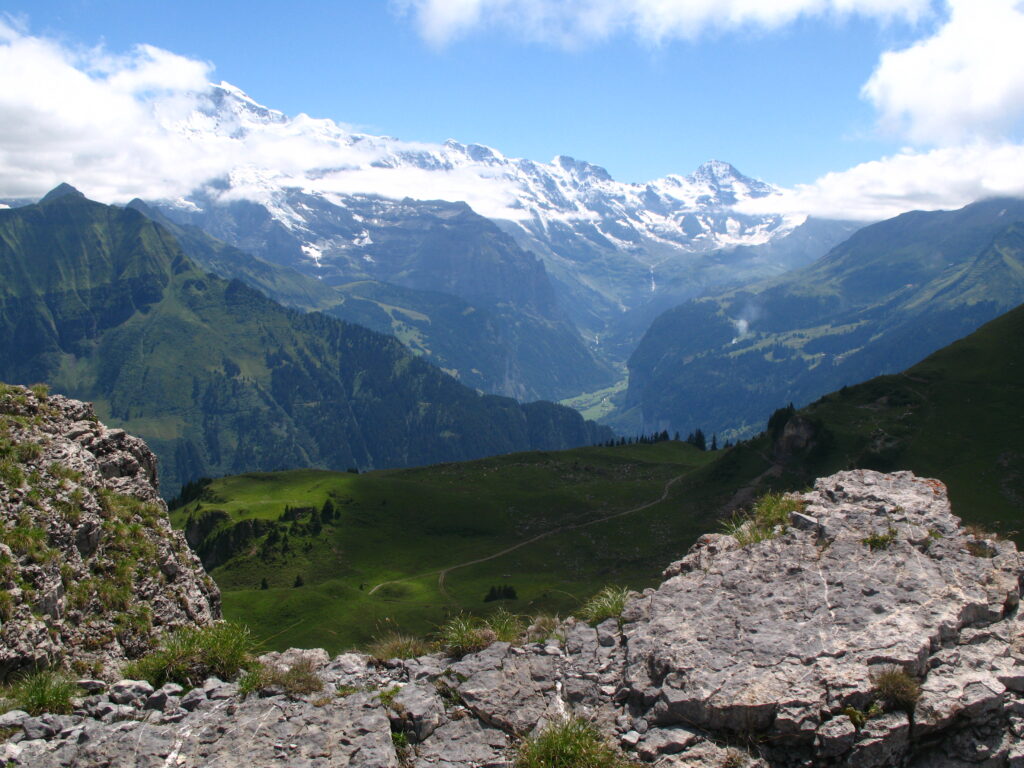
The following month he walked alone from Interlaken toward Lauterbrunnen, through the limestone gorge that runs beside the old road — a gorge whose name, the Wagnerenschlucht, is a medieval word for wagonmakers who worked this route centuries before the composer was born. He shared his name with a trade. He walked through it anyway, up through the valley, and climbed to the meadow above Wengen where the Jungfrau fills the horizon.
He wrote to his wife Minna that the mountain appeared “within arm’s reach.” He described the experience as nicht mitteilbar — non-communicable. The Alps exceeded language.
He found what he had needed. The following day he continued to the Faulhorn summit — 2,681 metres above sea level, roughly 800 metres of ascent above the Wengernalp, a full day of serious climbing. The Faulhorn hotel had been open since 1830, built by Samuel Blatter of Unterseen — one of the oldest mountain inns in the Alps, already a known destination for serious alpine travellers. Wagner was not yet forty and was not a casual hiker. He climbed to the top because the meadow had not been enough. From the Faulhorn summit, in clear conditions, seven Swiss lakes are visible: Brienz, Thun, Lucerne, Zug, Murten, Neuchâtel and Biel. The view northward reaches the Black Forest. It is not a mountain view. It is a god’s view.
The Terribly Sublime Mountains
Wagner recorded it accordingly. He described the summit panorama of “mountains, ice, snow and glaciers” as furchtbar erhaben — terribly sublime. Wagner’s German always found the mot juste. Terribly sublime was correct. Everything else he wrote about the experience fell short of those two words.
Whether the Alps confirmed what he had already written or fed into what he was still composing cannot be fully answered from the documentary record. What is documented is the timing: Wagner was in this landscape in the weeks the music was being completed. The Ride of the Valkyries — the famous opening of Act III, the Valkyrie motif building in the brass — is not abstract music. It has topography. It has the shape of mountains, the weight of ice, the speed of wind moving across exposed rock. He came here in crisis, found the scale he was looking for, and took it home in the music. The sound of the Ride of the Valkyries has sounded like these mountains ever since.
The Confluence
Mendelssohn had been on the Wengernalp meadow a decade before Wagner — 1842, in the same silence, making sketches. That same year he had also climbed the Faulhorn. The mountain was already a creative pilgrimage site for European composers before Wagner arrived. Tchaikovsky arrived in 1884, thirty-two years after Wagner, on the same meadow, with Byron’s Manfred in his hands. Tolkien was here in 1911. The meadow does not change what you bring to it. It amplifies it. Wagner brought Valhalla. The meadow confirmed that Valhalla was real.
Stand Here and Things to Do
Stand on the Wengernalp meadow, above Wengen. Then listen to the Ride of the Valkyries.
Take the Wengernalpbahn from Wengen station — twenty minutes to 1,874m. Walk ten minutes west to the open plateau. Face southwest: the full north wall of Eiger, Mönch, and Jungfrau. Wagner looked at this and wrote one word: nicht mitteilbar. Non-communicable. Then put on the Ride of the Valkyries and communicate it anyway.
Walk the Wagnerenschlucht from Matten toward Lauterbrunnen
The gorge path begins near the Rugenbräu brewery in Matten, 15 minutes on foot from Interlaken Ost. The medieval wagonmakers’ road Wagner walked in July 1852. Allow 1.5 hours one-way to Lauterbrunnen. The gorge name predates the composer by centuries.
Walk to the Faulhorn from First above Grindelwald
Wagner climbed to the Faulhorn summit (2,681m). Standard route from First above Grindelwald (2.5 hours). The summit panorama includes the full Bernese Alps. Mountain boots recommended.
Visit the Rugenbräu brewery, Matten
The Rugenbräu beer cellar (1872) is built into the cliff face of the Wagnerenschlucht. Still operating as a brewery and restaurant. Open daily.
Read the full Wagner story: iconsofinterlaken.com/discover/wagner/
Icon 30 — Richard Wagner
The Storm
Era 5 — The Romantic Zenith (1816–1865)
Loop: Mountain Myths — Hallowed Heights
Primary location: Wengernalp meadow · Wagnerenschlucht
In July 1852, Wagner walked to the meadow above Wengen with the freshly written libretto of Die Walküre and found the landscape he had already written, waiting for him. He called it non-communicable. He put it in the music anyway. The Ride of the Valkyries has sounded like these mountains ever since.
Discover the full story → iconsofinterlaken.com/discover/wagner/
Icons of Interlaken maps 55 remarkable figures across the Jungfrau Region of Switzerland. Explore the full project →