On 21 August 1842, Felix Mendelssohn stood in the medieval square in Unterseen and drew the Jungfrau. The sketch survives: the church tower of the Unterseen Stadtkirche frames the left side of the composition, and the white summit of the Jungfrau fills the sky at the upper right. It is thought to be the earliest extant visual depiction of this specific view — a view that has since been reproduced millions of times in photographs, paintings, and postcards. Mendelssohn made it first.
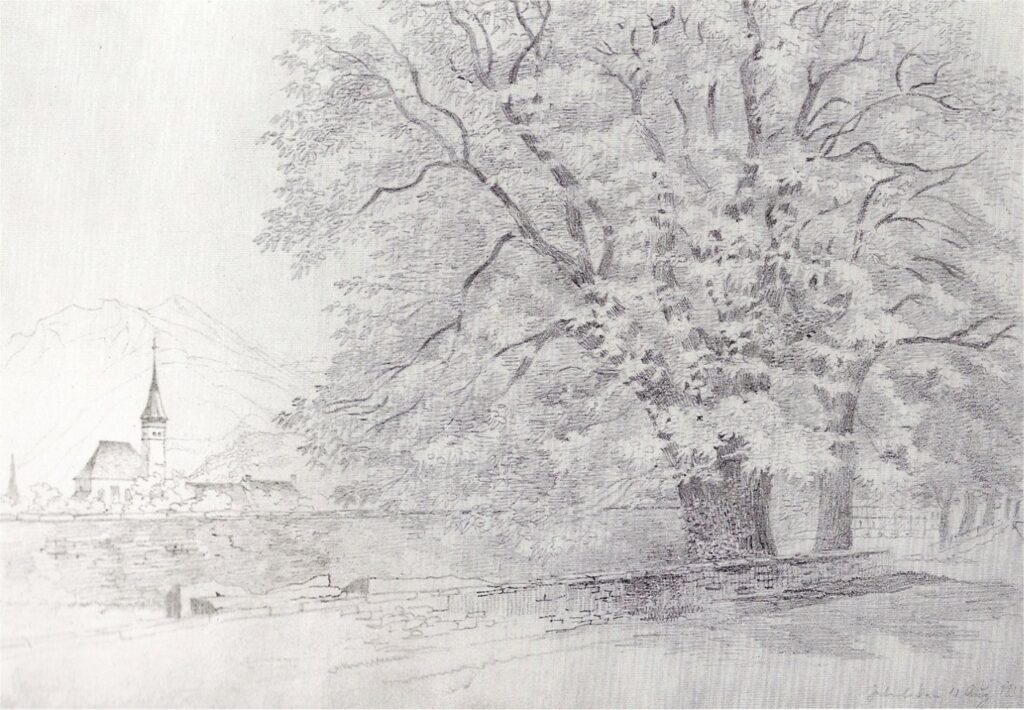
He had been travelling the Bernese Oberland for two weeks, conducting in some of the most celebrated concert halls in Europe, managing the demands of a career that required him to be in several places simultaneously. He came to the valley in the way all the great creative figures come to it — not on holiday in any ordinary sense, but in search of something the rest of the calendar couldn’t provide.
He then walked up to the Wengernalp meadow — the same meadow where Wagner would stand ten years later, where Tchaikovsky would sit in 1884 — and sat opposite the full north wall of the Eiger, Mönch, and Jungfrau. A second sketch, from a slightly different angle. And then, according to the hotel’s own records, a state of complete absorption. The staff remembered it. He sat in silence for hours.
He composed no symphony in response to the Bernese Oberland. He made two sketches and kept a silence and wrote in his letters that the mountains were larger than music. This is the most remarkable statement in the project: the composer of the Scottish Symphony, the Violin Concerto in E minor, the Midsummer Night’s Dream overture — one of the most prolific creators in the history of European music — came to the Wengernalp and decided that what he saw was beyond his medium. He did not try to make it more.
A biographical detail connects him to the broader valley story: the chair that Goethe had given to Mendelssohn ended up in the possession of Clara Schumann, who was staying in Wilderswil in the 1880s with the chair in her rented house, looking at the same Jungfrau Mendelssohn had sketched forty years earlier. Objects, in this valley, accumulate the same way stories do.
The Confluence
Three composers and a mythographer stood on the Wengernalp meadow across seventy years: Mendelssohn in 1842, Wagner in 1852, Tchaikovsky in 1884, Tolkien in 1911. None of them knew about the others. The geometry of the Silberhorn — the way it rises separately from the main massif, catching early light before the cloud builds — is unchanged from what Mendelssohn drew in 1842 and Tolkien looked at in 1911. The meadow does not change what you bring to it. It amplifies it. Mendelssohn brought music and found something that exceeded music. He had the honesty to leave it there.
Stand Here
Unterseen Stadthausplatz, then the Wengernalp meadow.
Stand first in the medieval square in Unterseen — a 10-minute walk from Interlaken Ost across the Aare bridge — and face the Stadtkirche tower. The Jungfrau is visible above and to the right on clear days: exactly the composition Mendelssohn drew on 21 August 1842. Then take the train to Lauterbrunnen, the Wengernalpbahn to the plateau, and walk to the open meadow. Sit in front of the same view he sat in front of. The silence is still available. The mountains are still larger than music.
Read the full Mendelssohn story: iconsofinterlaken.com/discover/mendelssohn/
Things to Do: In Mendelssohn’s Footsteps
- Stand in Unterseen Stadthausplatz
The medieval market square in Unterseen — 10 minutes on foot from Interlaken Ost — faces the Stadtkirche tower with the Jungfrau visible above it on clear days. Mendelssohn’s 1842 sketch was made from this square. Open at all times; no admission. - Walk to the Wengernalp meadow and sit opposite the Jungfrau
Train to Lauterbrunnen (12 min), Wengernalpbahn to Wengernalp (20 min), 10-minute walk west to the open plateau. This is where Mendelssohn sat in complete absorption in 1842. Allow at least an hour. - Follow the Mendelssohn–Clara Schumann connection
Mendelssohn received a chair from Goethe; the chair passed to Clara Schumann; Clara was in Wilderswil in the 1880s. Train from Interlaken Ost to Wilderswil takes 8 minutes. The Schynige Platte rack railway departs from Wilderswil. - Visit the Tourismuseum Interlaken, Unterseen
Documents the cultural history of the Bernese Oberland including original period prints and documentation of key visitors. Located in the Städtli Unterseen. Opening hours at tourismuseum.ch.
Icon 29 — Felix Mendelssohn
The Soul
Era 5 — The Romantic Zenith (1816–1865)
Loop: Mountain Myths — Hallowed Heights
Primary location: Wengernalp meadow · Unterseen Stadthausplatz
The composer of the Violin Concerto stood on the Wengernalp meadow in 1842 and sat in silence for hours. He said the mountains were larger than music. He made two sketches and left the rest where it was. The silence he found here is still available.
Discover the full story → iconsofinterlaken.com/discover/mendelssohn/
Icons of Interlaken maps 55 remarkable figures across the Jungfrau Region of Switzerland. Explore the full project →