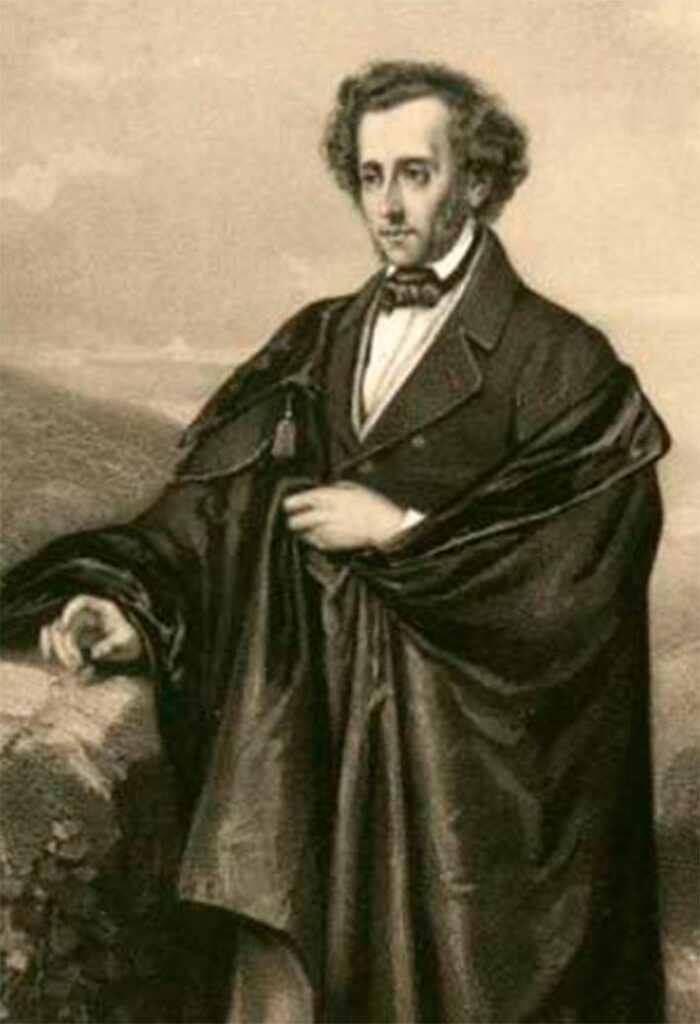
Mendelssohn’s relationship with Switzerland runs deeper than a single sketch. His Alpine travels, across several summers, fed directly into the maturing of his compositional voice — the sense of scale and structure that critics have long noted in his later orchestral work owes something, even if it resists precise attribution, to the landscapes he kept returning to. The sketches he made on these trips are less well known than the music, but they form a parallel record of the same attention: a composer working out, in a medium he hadn’t trained in, what he couldn’t yet say in the medium he had.
Mendelssohn’s Lost Sketch and The Earliest Drawing of the Jungfrau Massif
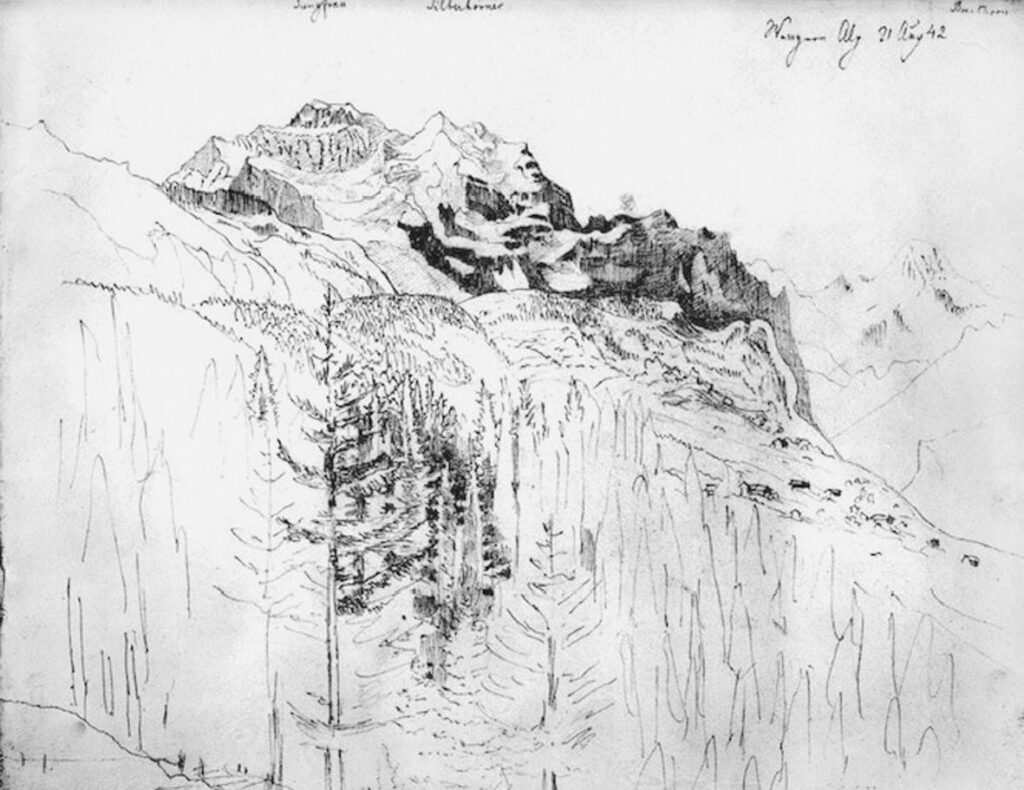
The 21 August 1842 sketch belongs to this body of work, and it belongs specifically to the Wengernalp — to the meadow that, by the time Mendelssohn arrived, had already been hosting travellers for decades in the small cluster of Sennhütten and Schirmhütten that served as the only shelter before the inn opened in 1835. Among these buildings, the Wykibort hut: a cowbyre dating, as far as the available record allows us to say, from the early nineteenth century or possibly older — meaning that by 1842, it had likely already stood on this ground for decades, a fixture of the meadow’s working life that Mendelssohn would have walked past, and possibly sketched without recording, on his way to the spot where the view opened out.
If that sounds glorious and fun to you…well Mendelssohn thought it was the opposite of that. Felix Mendelssohn recounted the stay in the Alpine hut on Wengernalp:
“An Alpine hut is, incidentally, not as poetic as one might well imagine (…) It is with difficulty that one makes it inside, for the hollow in which every hut stands is so fouled by the cows that one can only reach the door by stepping on stones and wooden boards that the herdsmen throw into the muck. A partition of planks divides this fine building into two parts. In the front section are a window and two doors. Here is where we sat down (…) The porters and guides retreated to the rear compartment and made a fire there, around which they settled; every now and then someone would also come over and warm themselves, for the cold was severe (…)”
The visual detail is worth dwelling on. Mendelssohn sketching the sublime — three peaks resolving into a single, almost classical composition — would very likely have had, somewhere in his peripheral vision or directly behind him, or in the memory he just described, the unglamorous working life of a cowbyre: animals, herders, the smoke of a fire, the practical business of an Alpine summer continuing exactly as it had for years. The high Romantic sketch and the working farm building occupy, quite literally, the same small patch of grass. Neither one is more real than the other. They are simply two different registers of the same place, recorded — or not recorded — by the same set of eyes on the same August afternoon.
Wengen’s own commemoration of this visit — the trail, the annual week — is evidence that this story has never entirely disappeared from local memory, even if it has faded from wider awareness. This post exists to connect the dots fully: the meadow Mendelssohn sketched, the cowbyre that watched him do it, and the building that, nearly two centuries later, still occupies that ground as the Wyki Washbar & Cheese Bar.
Tolkien’s Misty Moutains & Silberhorn in Mendelssohn’s Jungfrau sketch
What is remarkable in the Mendelssohn sketch is the prominence of the Silberhorn peak. The peak that Tolkien, when hiking past it on his 1911 trip, would call the mountain of his dreams and which became the Celebdil and Zirakzigil fixed about the Khazad-dûm (Moria). Mendelssohn sketched the ‘Misty mountains‘ in the exact angle where it mesmerized Tolkien and makes the Silberhorn look more impressive, prominent, triangular and beautiful than the Jungfrau. It is this rare view from the Wengernalp that hypnotized Tolkien and Mendelssohn and all the romantic travellers of that time (including Wagner who found Valhalla here).
The Confluence
Mendelssohn’s 1842 visit sits ten years before Wagner’s and forty-two years before Tchaikovsky’s, on the same meadow, looking at the same composition. It also connects to the painters who worked this same view — König and Hodler chief among them — in oil rather than pencil. Different mediums, different decades, the same single, unrepeatable arrangement of rock and ice doing the same work on each of them.
Stand Here
The open meadow facing the massif, near the present Wyki Waschbar.
This is, as far as the record allows, roughly where the 1842 sketch was made. Stand here, sketchbook or phone in hand, and notice how little has changed about the composition — and how much has changed about everything else.
Discover Icon 29 — Felix Mendelssohn → iconsofinterlaken.com/discover/mendelssohn/
Things to Do
- Walk the Mendelssohn Trail from Wengen — Wengen has run an annual Mendelssohn Week and a dedicated Mendelssohn Trail since 2005, anchored to this exact location. The trail is well marked and manageable for most walkers.
- Stand at the meadow viewpoint near the Wyckibort hut — The Wyki Waschbar — the Wyckibort hut — sits close to the likely vantage point of the 1842 sketch. Attempt your own version; phones count.
- Time a visit to Mendelssohn Week, if dates align — Check current dates on the Wengen tourism calendar; the week is timed to roughly coincide with Mendelssohn’s own August visit.
- Cross-reference with the painters’ post — König, Hodler, and a long list of other landscape painters are documented at this same meadow. Read the fuller visual-arts thread in the article on the Wengernalp’s painters.
Icon 29 — Felix Mendelssohn
The Sketcher Primary location: Wengernalp meadow On 21 August 1842, Mendelssohn sat in silence on the Wengernalp meadow for several hours and produced what is believed to be the earliest surviving drawing of the Jungfrau massif from this vantage — a parallel creative output to the music for which he is far better remembered.
Discover the full story → iconsofinterlaken.com/discover/mendelssohn/