A blog post for iconsofinterlaken.com · Category: Mountain Myths
The Meadow That Collects Geniuses
Long before J.R.R. Tolkien carried the shape of the Silberhorn back to Oxford and turned it into Celebdil above the Mines of Moria, and decades before Richard Wagner stood on this same high pasture with the Die Walküre libretto in his coat and Pyotr Tchaikovsky sat inside its hotel reading Byron, a thirteen-year-old boy from Berlin climbed up here with his family, looked for somewhere dry to put his feet, and wrote down exactly how unglamorous the experience was.
It was late August 1822. Felix Mendelssohn — not yet the famous composer the world would come to know, just a sharp, restless prodigy on his first trip outside Germany — had spent the day walking up from Interlaken through the Lauterbrunnen valley to the Wengernalp, the open meadow that sits directly across from the glaciated north faces of the Eiger, Mönch, and Jungfrau. The family needed shelter for the night. What they found was a Sennhütte — a cowherd’s summer hut — and Felix, already carrying the sketchbook and the sharp eye he’d keep for the rest of his life, wrote it up with the deadpan honesty of a smart kid who’d expected something more romantic. This single overnight stop is the first documented eyewitness account Icons of Interlaken has found of the exact kind of high-pasture shelter that would, ninety years later, give a teenage Tolkien somewhere to sleep on the very same route — the walk told in full in J.R.R. Tolkien in the Lauterbrunnen Valley: The Walk That Built Middle-earth.
Who Was Felix Mendelssohn — And Why Does He Matter to This Valley?
If the name means nothing to you, here’s the short version. Felix Mendelssohn (1809–1847) was one of the defining composers of the Romantic era — the mind behind the Wedding March that has played at more weddings than almost any other piece of music ever written, the Violin Concerto in E minor, the Hebrides Overture, and the “Scottish” and “Italian” symphonies. He was also a genuine child prodigy, taken by his teacher to meet an elderly Goethe when he was twelve, and composing string symphonies before most children have finished learning scales.
What’s less well known is that Mendelssohn was also a serious amateur landscape artist. He carried a sketchbook on every journey of his life and left behind roughly eighty surviving watercolours, most of them made in the mountains and valleys that captivated him most: the Swiss Alps, and above all the Bernese Oberland. He travelled through this region four separate times across twenty-five years — 1822, 1831, 1842, and 1847 — and each visit left its mark, on paper and eventually in his music.
The Story: Four Journeys, One Composer, One Mountain
1822 — A Family Holiday and a Night in a Cowherd’s Hut on the Wengernalp
The 1822 trip was a full family expedition: banker father Abraham, watchful mother Lea, seventeen-year-old sister Fanny (herself a formidable composer, though the era gave her far fewer chances to be heard), a tutor, and household staff, travelling by carriage as far as the terrain allowed and on foot the rest of the way. Between 26 and 28 August, the party crossed from Lauterbrunnen through Wengen and up onto the Wengernalp — Felix’s first real look at the mountain that would occupy him, on and off, for the rest of his short life.
The Sennhütte where they sheltered that night has never been definitively pinned to a single surviving building. What survives is Mendelssohn’s own account of what it was actually like inside — and it is refreshingly unromantic. A single structure divided by a plank partition into two rooms. One window, two doors at the front, where the family sat. In the back room, the porters and mountain guides lit a fire and gathered around it against a cold Mendelssohn called severe. Getting to the door at all meant picking your way across boards the herders had thrown down over ground churned into mud by the cattle. It is, in every detail, exactly the category of building that has sheltered footsore travellers on this route for centuries — the same category of building that would later give a much younger traveller, on a much longer walk, somewhere to lay his head when the inns were full.
Felix Mendelssohn recounted the stay in the Alpine hut on Wengernalp:
“An Alpine hut is, incidentally, not as poetic as one might well imagine (…) It is with difficulty that one makes it inside, for the hollow in which every hut stands is so fouled by the cows that one can only reach the door by stepping on stones and wooden boards that the herdsmen throw into the muck. A partition of planks divides this fine building into two parts. In the front section are a window and two doors. Here is where we sat down (…) The porters and guides retreated to the rear compartment and made a fire there, around which they settled; every now and then someone would also come over and warm themselves, for the cold was severe (…)”
Which exact Sennhütte he describes is unclear. The Wykibort Hut on the Wengernalp though, is the oldest still standing hut from that era and radiates that same low-key, plank like simple and sturdy structure. When visiting the Wengernalp go have a look and you can feel the history radiating from it. 91 years later a young J.R.R. Tolkien would hike this same meadow and describe staying in cowbyres. Might they have stayed in the same place? We like to believe so….
1842 — The Earliest Surviving Drawing of Wengen & the Jungfrau
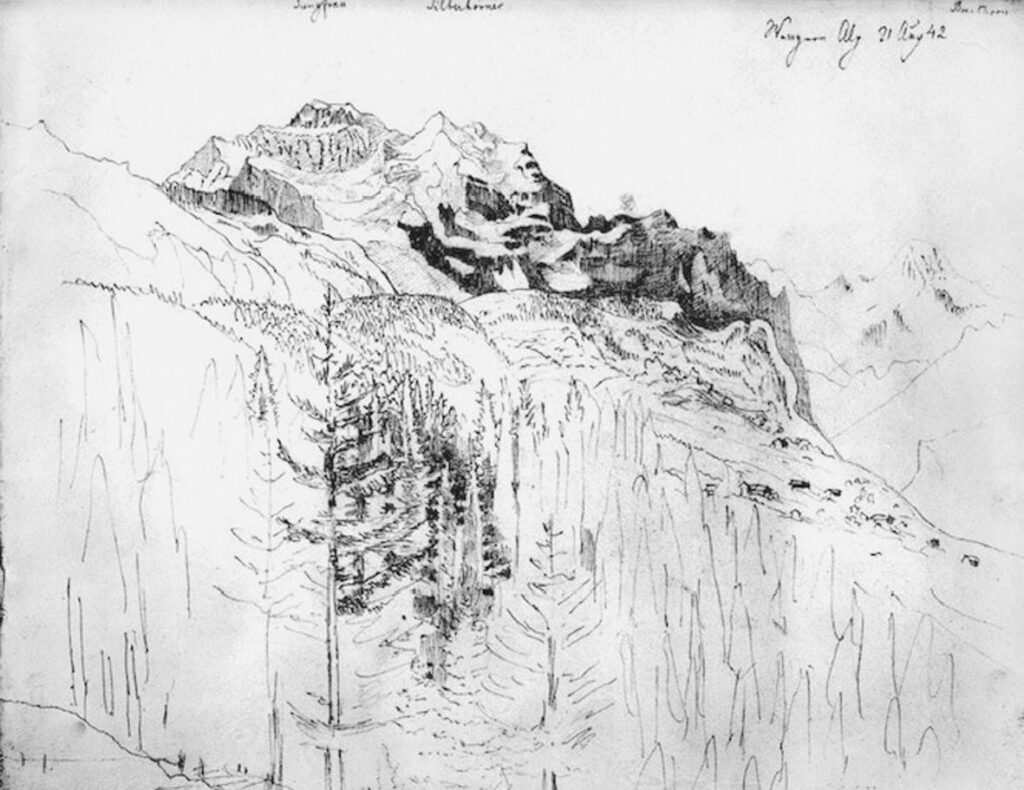
Twenty years later, Mendelssohn returned a famous man. He was now one of the most celebrated composers and conductors in Europe, travelling with his wife Cécile on his way to conduct at a Swiss music festival in Lausanne. On 21 August 1842 — his third visit to Wengen — he stopped, sketchbook in hand, and made a spontaneous, uncoloured drawing of the village with the full Jungfrau massif rising behind it.
That drawing is thought to be the earliest surviving depiction of Wengen ever made — the first time in recorded history anyone had put this exact view on paper. Twenty years after a boy had grumbled about the mud outside a cowherd’s hut, a man stood on almost the same ground and drew, for the first time, the mountain that had apparently been waiting for him the whole time.
The Music That Came Out of the Mountains
Mendelssohn never wrote a piece called “The Jungfrau.” The valley went into his music in smaller, stranger pieces instead. His letters describe hearing yodelling drift across the pastures at dawn to the sound of cowbells — beautiful and stirring outdoors, he noted, in sharp contrast to how harsh the same singing sounded indoors. His very first Swiss journey in 1822 planted the seed for his fiery Piano Quartet in C minor, Op. 1. Later works absorbed what he’d heard directly on these hillsides: a yodel quoted in the trio of his string symphony known as “La Suisse,” alphorn motifs worked into other movements, and — surfacing years later inside his Eleventh String Symphony — an Emmental wedding dance he must have heard at some village celebration along the way.
He returned once more in 1831, walking alone from Italy, and a final time in 1847, in the exhausted last months of his life, seeking some relief in the Oberland after the sudden death of his beloved sister Fanny. He died later that same year, at just thirty-eight.
The Confluence: Four Icons, One Meadow, Seventy Years
Mendelssohn’s overnight stop in 1822 sits at the start of a much longer chain of figures who stood on this exact meadow and found something they hadn’t expected. Richard Wagner walked through in 1852, carrying the newly completed libretto of Die Walküre, and wrote home that the Jungfrau appeared “within arm’s reach” — an experience he called simply non-communicable, a story told in full in Wagner and the Wengernalp: Valhalla in the Alps. Pyotr Tchaikovsky sat inside the hotel here in 1884 reading Byron’s Manfred, and left with the symphony that bears its name half-composed in his head — see Tchaikovsky and the Manfred Symphony: The Witch He Found at the Wengernalp. And in 1911, J.R.R. Tolkien — a nineteen-year-old scholarship student on his first trip abroad — passed through on foot with a party of school friends, sleeping in cowbyres as the proper inns were too expensive, and carried the sharp outline of the Silberhorn – the triangular mountain just across from the Wengernalp – home to Oxford. Thirty-three years later he would turn it into Celebdil, the Silver Horn that rises above the Mines of Moria in The Lord of the Rings.
None of these four — composer, composer, composer, mythmaker — knew about the others. The meadow doesn’t keep a record of names. It just keeps offering the same view, the same shelter, and the same cold nights to whoever is willing to climb up and take them.
The Building Behind the Bar: Mendelssohn’s Sennhütte and the Wyckibort Hut
The building most closely associated with this tradition of overnight shelter today is the Wyckibort hut, documented on an 1864 cadastral map and now operating in winter as the Wyki Washbar après-ski bar and in summer still like a traditional Sennhütte. Local research describes it as “early nineteenth century, possibly older” — whether it predates Mendelssohn’s 1822 family visit is a question still being actively researched, not a fact anyone should print as settled. What can be said honestly is this: Mendelssohn’s account is the earliest first-hand description Icons of Interlaken has found of exactly the kind of hut a traveller on the Wengernalp route would have slept in — plank floor, divided rooms, a fire kept going in the back for the guides. It reads like the floor plan for the very culture of shelter that, ninety years later, gave Tolkien somewhere to sleep on the same ground.
Stand Here: The Wengernalp Meadow and the Mendelssohn Memorial
The Wengernalp meadow, above Wengen — site of the 1842 sketch.
Take the Wengernalpbahn from Wengen station to the Wengernalp halt and walk out onto the open pasture. Face the Jungfrau up close exactly as Mendelssohn did twice, twenty years apart — once as a grumbling thirteen-year-old looking for the door of a cowherd’s hut, once as a celebrated composer with nothing better to do than sit still and draw. The mud is mostly gone. The mountain hasn’t moved.
Read the full Mendelssohn story: iconsofinterlaken.com/discover/mendelssohn/
Things to Do in Wengen and on the Wengernalp: In Mendelssohn’s Footsteps
1. Ride the Wengernalpbahn from Wengen to the meadow The rack railway climbs in about twenty minutes through forest and then open pasture. Disembark at the Wengernalp halt and walk south onto the plateau — this is the ground the Mendelssohn family crossed on foot in 1822.
2. Visit the Mendelssohn memorial site above Wengen Marks the spot of the 1842 sketch — the earliest known drawing of Wengen and the Jungfrau together. The access path closes in winter due to avalanche risk, so check locally before setting out.
3. Stand at the Wyki Waschbar and picture the older building beneath it Today an après-ski bar and slopeside restaurant during the ski season this site carries a documented history back to the early 1800’s. It sits in exactly the kind of location — high pasture with the most popular view of the Romantic 19th century — where a family, or a solo teenage walker, would have looked for a roof over their head for the night.
4. Catch the Mendelssohn Musikwoche in Wengen Held annually in August, this festival programmes Mendelssohn’s own works alongside pieces by his sister Fanny Hensel-Mendelssohn and his wider circle, performed in the valley he kept returning to across twenty-five years.
Bonus: See the same meadow at 140 kilometres per hour Every January, the same Wengernalp plateau that Mendelssohn sketched in silence becomes part of the course for the Lauberhorn Race, the fastest downhill event in Alpine skiing. Discover Icon 50 — The Lauberhorn Race, The Fastest.
Connector Note
Mendelssohn’s Sennhütte account sits at the start of a chain that runs through Wagner (1852), Tchaikovsky (1884), and Tolkien (1911) — four figures, seventy years, one meadow. It’s also the earliest primary-source description Icons of Interlaken has found of the specific building type — plank floor, divided rooms, a fire kept going for the porters — that later sheltered Tolkien on the same route. The Wyckibort hut’s own history is still being confirmed; until it is, this connection is offered as resonance, not proof.
Discover the Icons Journey → iconsofinterlaken.com/discover/